Why Every Business Should Carry Out a Professional WiFi Survey
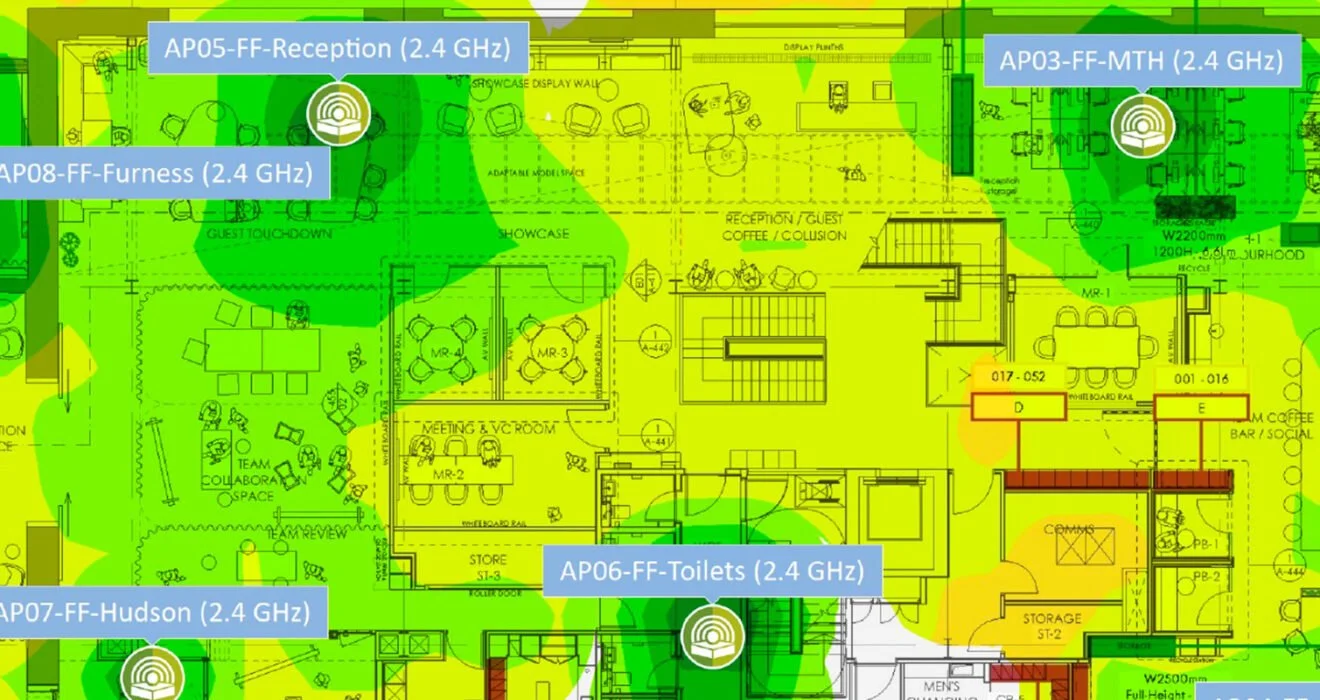
Reliable WiFi has become a critical business requirement. From cloud applications and VoIP telephony to barcode scanning, mobile devices, CCTV, and guest access, organisations rely on wireless connectivity more than ever before.
Yet many businesses still deploy WiFi networks based on assumptions rather than data.
A common misconception is that improving WiFi performance simply requires installing more access points. In reality, adding more hardware without understanding the environment can often make performance worse.
This is why professional WiFi surveys are one of the most important steps in designing, upgrading, or troubleshooting any wireless network.
What Is a WiFi Survey?
A WiFi survey is a detailed assessment of a building or site that measures and analyses wireless coverage, signal strength, interference, and performance.
Using specialist software and survey equipment, engineers can map how WiFi signals behave throughout a site and identify areas that may suffer from:
Poor coverage
Signal overlap
Dead zones
Interference
Roaming issues
Capacity limitations
The information gathered allows networks to be designed based on real-world data rather than guesswork.
Why WiFi Performance Matters
In many organisations, WiFi is now the primary method of connectivity.
Employees expect seamless access to applications and data wherever they are working. Warehouse operators rely on wireless barcode scanners and mobile computers. Healthcare providers depend on mobile devices to access critical information. Visitors expect reliable guest internet access.
When WiFi performance is poor, productivity suffers.
Common complaints include:
Slow internet speeds
Dropped connections
Poor call quality
Devices failing to roam correctly
Applications timing out
Intermittent connectivity issues
In many cases, these problems can be traced back to poor wireless design.
Every Building Is Different
One of the biggest challenges with WiFi is that radio signals are affected by the physical environment.
Factors that can impact performance include:
Building construction materials
Concrete walls
Steel structures
Machinery
Storage racking
Glass partitions
Electrical equipment
Other wireless networks
A warehouse, for example, presents very different challenges to an office environment.
High-level metal racking can block and reflect wireless signals, while constantly changing stock levels can alter signal propagation over time.
Without a survey, it is impossible to accurately predict how WiFi will perform once installed.
The Cost of Guesswork
Many businesses invest heavily in network equipment only to discover that performance falls short of expectations.
Typical issues include:
Too Few Access Points
Coverage gaps leave users unable to connect in certain areas.
Too Many Access Points
Excessive access points can create interference and reduce performance.
Poor Access Point Placement
Even high-quality equipment can underperform if positioned incorrectly.
Capacity Problems
A network may provide coverage but struggle when large numbers of users connect simultaneously.
Roaming Issues
Users moving between coverage areas may experience dropped connections or interrupted voice calls.
A professional survey helps eliminate these risks before they become expensive problems.
Types of WiFi Survey
Predictive Surveys
A predictive survey uses building plans and modelling software to design a wireless network before installation.
This approach helps determine:
Access point locations
Expected coverage
Capacity requirements
Hardware selection
Predictive surveys are ideal for new buildings and refurbishment projects.
Validation Surveys
A validation survey is carried out after installation to confirm that the network performs as designed.
This verifies:
Coverage levels
Signal quality
Roaming performance
Capacity targets
Validation surveys provide confidence that the investment has delivered the expected results.
Troubleshooting Surveys
When users experience connectivity issues, a survey can identify the root cause.
Engineers can detect:
Interference
Coverage gaps
Channel conflicts
Network congestion
Hardware faults
This enables problems to be resolved quickly and accurately.
WiFi Surveys for Warehouses and Industrial Sites
Warehouses and industrial facilities are among the most challenging environments for wireless networking.
Large open spaces, high racking, machinery, and constantly changing layouts create unique challenges that cannot be addressed through standard office WiFi design principles.
A professional survey helps ensure reliable connectivity for:
Barcode scanners
Mobile computers
Forklift terminals
VoIP handsets
Tablets
CCTV systems
IoT devices
For businesses that depend on real-time data and inventory systems, reliable WiFi is essential to maintaining operational efficiency.
The Long-Term Benefits
Investing in a WiFi survey delivers benefits far beyond the initial installation.
Organisations typically experience:
Improved reliability
Better user experience
Reduced downtime
Faster troubleshooting
Lower support costs
Greater confidence in network performance
Improved return on investment
Most importantly, a survey ensures that your wireless network is designed to support both current and future business requirements.
Why Work with SynTechnologies?
At SynTechnologies, we understand that every environment is different.
Our experienced engineers carry out professional WiFi surveys using industry-leading tools to assess coverage, capacity, performance, and interference. Whether you’re planning a new installation, expanding an existing network, or investigating connectivity issues, we provide the data and expertise needed to make informed decisions.
From offices and schools to warehouses, manufacturing facilities, and multi-site organisations, we help businesses build wireless networks that deliver reliable performance where it matters most.
If you’re planning a WiFi project or experiencing wireless issues, contact SynTechnologies to discuss how a professional WiFi survey can help you get the most from your network.